








Understanding the PPWR
- June, 2026
The EU Packaging Regulation, also known as the Packaging and Packaging Waste Regulation, aims to prevent packaging waste and promote recycling opportunities. It also encourages the reuse of packaging in order to minimise the environmental impact of packaging and packaging waste.
PPWR - a shift from directive to regulation
PPWR - a shift from directive to regulation
We are currently in a shift in legislation, moving from a packaging and packaging waste directive (PPWD) to a regulation (PPWR) at EU level. This means a greater harmonisation of packaging legislation among EU countries regarding labelling, EPR responsibilities, and guidelines.
New targets and requirements are also on the way, e.g., technical documentation, setting recycling standards, tightening, and clarifying eco-modulated design criteria to fit recycling facilities’ capabilities, and improving recycling rates.
Extended producer responsibility (EPR) is a concrete and mandatory measure as part of the PPWR - Packaging and Packaging Waste Regulation.
EPR plays an essential role under PPWR
EPR plays an essential role under PPWR
What is the Extended Producer Responsibility (EPR) about?
The Extended Producer Responsibility (EPR) scheme shifts the waste responsibility of packaging placed on the EU market from the consumer to the producer.
How does this affect you?
Packaging producers have become responsible for the waste treatment of their packaging put on the EU market.
Setting up an EPR scheme is now mandatory in all EU countries. However, companies lack the resources and skills to treat packaging waste. Consequently, every EU country created a national collective scheme to take care of this task while requiring a fee for the treatment. This means that a fee is set in all EU countries for producers placing packaging on the EU market.
It is important to note that every country currently has an EPR fee that can vary, even on a national level, depending on the chosen PRO.
We prepare you for future packaging compliances
We prepare you for future packaging compliances
Packaging design can be complex. That is why we keep track of EU legislation about packaging coming into force. We can advise and guide you to make the best packaging solutions for your brand while complying with legislation and promoting conscious practices in your packaging design.
In the near future, the packaging industry will also be affected by the European Green Deal in different ways, such as the ESPR (Ecodesign for Sustainable Products Regulation) and SUP (Single Use Plastics Directive).
We know many of our customers are aligning their targets with the Green Deal. That is why we offer carbon footprint screening and circular packaging solutions and stay up to date with legislation and targets.
Shall we help you future-proof your packaging?
Yes, thank you, I would like to be contactedEPR rules - what to do
EPR rules - what to do
If you trade or sell packaging to an EU country, check the local rules regarding labelling requirements, registration timelines and EPR fees.
In all EU countries, the EPR requires:
- Registration of the quantity in kg of packaging placed in each EU country and payment of the contribution fee via a PRO.
Contact the relevant national EPR schemes to learn about the different national registration timelines.
- In EU countries, material labels are defined and in some countries are mandatory. Labels provide information about the material so that customers can easily sort the packaging correctly and contribute to recycling the material as framed by the circular economy.
The official targets regarding the PPWR are to reach an overall of 65% recycled packaging by 2040 in the European Union.
How can you align with the PPWR?
How can you align with the PPWR?
At Scanlux Packaging, we continuously seek alternative and more sustainable solutions that align with EU legislations.
We offer to analyze your current packaging with a focus on design and compliance.
During your design meeting, we can discuss:
- Materials
- Design optimizations
- Reusability
- Recyclability
- Eco modulated fees
- Documentation required for the PPWR
- Overall packaging legislations.
Does your brand leave a lasting impression?
"Overall, packaging needs to be part of a more circular strategy."
Xénia Weulersse, ESG manager at Scanlux Packaging
Abbreviations
Abbreviations
PPWD:
The PPWD (Packaging and Packaging Waste Directive) is an EU law that sets overall goals for reducing the environmental impact of packaging, but as a directive, it must be implemented through national legislation, which has led to different rules, interpretations, and timelines across EU countries.
PPWR:
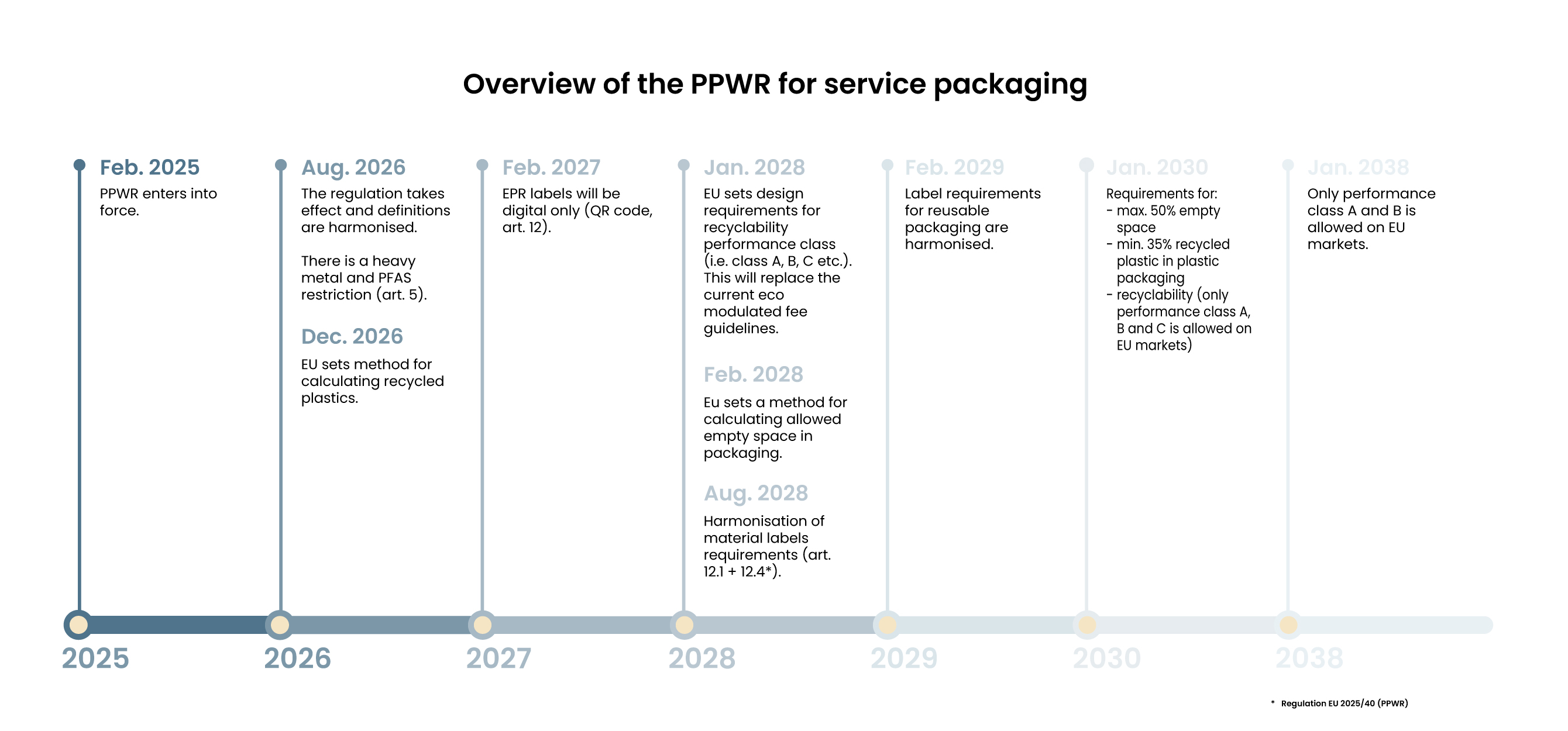
The PPWR (Packaging and Packaging Waste Regulation) is the new EU law that replaces the PPWD, by august 12th 2026. It sets harmonised rules to reduce packaging waste, with requirements phased in over a longer transition period (see timeline).
EPR:
EPR (Extended Producer Responsibility) is a policy approach—also part of the PPWR—that holds producers responsible for the environmental impact of their products, including collection, recycling, and disposal after use.
PRO:
A Producer Responsibility Organisation (PRO) is an entity that manages waste and recycling on behalf of producers, helping them meet their EPR obligations by organising the collection, sorting, and treatment of products at end of life.
Eco-modulated fees:
Eco‑modulated fees are charges producers pay for packaging, with the cost adjusted based on the packaging's environmental performance. Packaging that is easier to recycle or more sustainable pays lower fees, while less recyclable or more harmful packaging pays higher fees, encouraging better design choices.
Material label:
A material label under the PPWR is a standardised marking on packaging that identifies the materials it is made from, helping consumers sort waste correctly and ensuring consistent recycling across the EU.
Service packaging:
Service packaging is a packaging designed and intended to be filled at the point of sale for dispensing the product.
Let's talk
We would like to hear from you if you have any question or need a quote. Fill out this form and one of us will get it touch with your shortly.
Dive into our world
Article
What is up and down when choosing a packaging supplier?
It’s important that you make the right considerations about what is essential to your business before contacting a packaging supplier. Here, we provide you with an overview of what you should consider and ask your supplier about.
Article
Get your packaging strategy in 3 steps
Have you thought about your company’s packaging strategy? We find that many stores and webshops plan their packaging on a case-by-case basis. Is this your strategy too?
Creative Lab
Design is key
Let us invite you into a world of bold colours and patterns, magnificent materials and innovative designs.